
Menopause Is the Product
The market finally found us. Now we have to ask who gets to write the story. When the room suddenly looks different

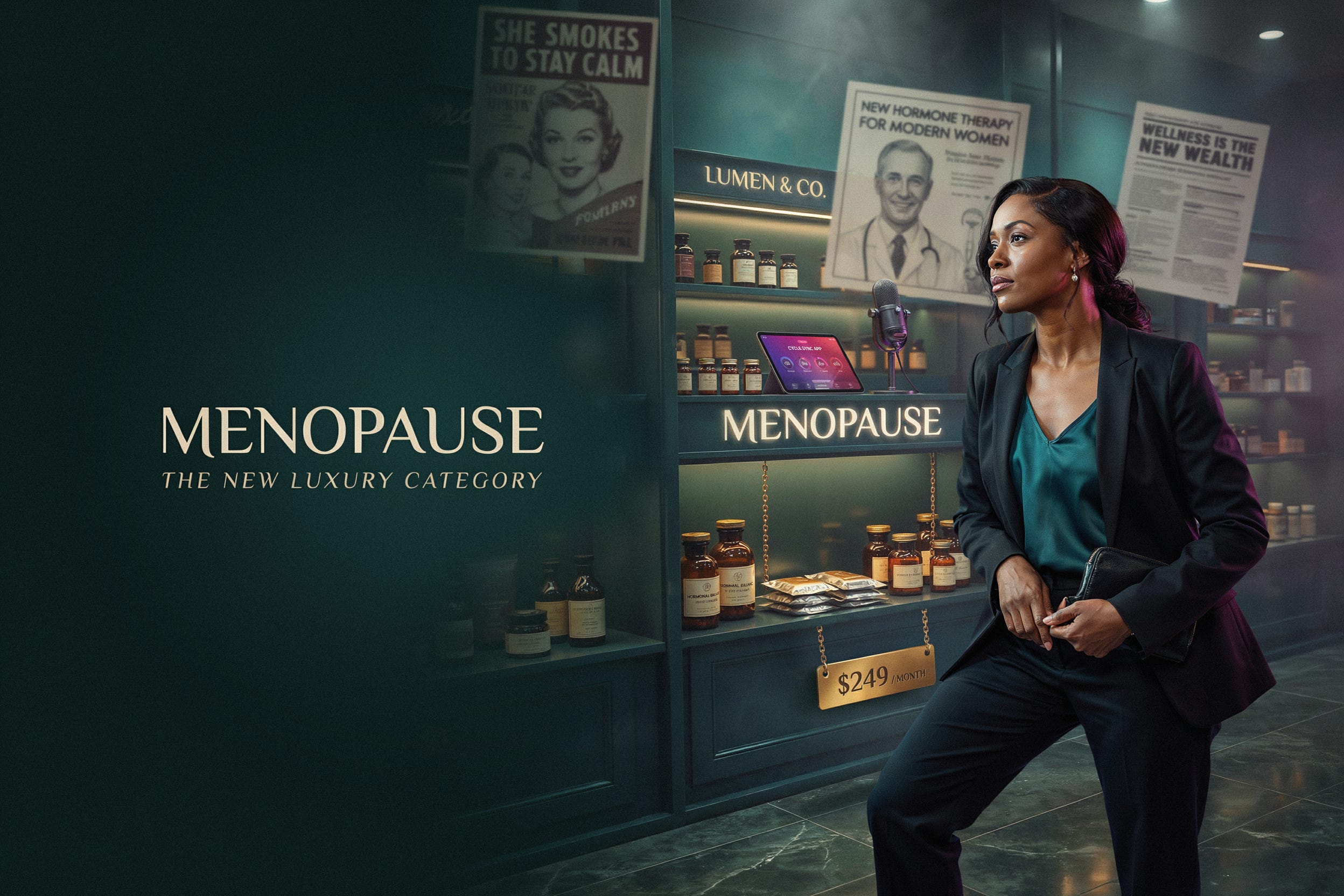
I was minding my business, reading another post about menopause being turned into a marketplace, when Edward Bernays walked into the room.
Not literally, obviously. But once I saw the pattern, I couldn’t unsee it.
That is how certain things work. They sit quietly in the background until one day the lighting changes, and suddenly the whole room looks different.
The post was asking a fair question: Are we actually talking about menopause, or are we using the word menopause to sell things?
That question has teeth because menopause is everywhere right now. It is in pitch decks, supplement ads, employer-benefit conversations, coaching programs, digital health platforms, workplace trainings, podcasts, hormone clinics, longevity spaces, wellness retreats and social media hooks. After decades of silence, dismissal and poor training, menopause is finally visible.
But visibility and understanding are not the same thing.
A woman can be seen by the market and still not be cared for by medicine. That is the part I keep sitting with.
When a long-ignored health issue finally becomes visible, the first instinct is to celebrate. Finally, people are talking. Finally, women are not whispering. Finally, hot flashes, brain fog, sleep disruption, vaginal dryness, painful sex, joint pain, mood shifts, palpitations, weight changes, rage, anxiety and exhaustion have language around them.
That matters.
But if you have lived long enough, practiced medicine long enough or watched enough American culture turn suffering into a sales category, you learn to ask another question right behind the celebration.
Who is writing the story now?
The cigarette didn’t become freedom
That is where Bernays enters for me.
Edward Bernays was one of the architects of modern public relations. He understood that people do not only buy products. They buy meaning. They buy identity. They buy relief from shame. They buy belonging. They buy the feeling that a purchase puts them on the right side of the future.
In 1929, Bernays helped create the “Torches of Freedom” campaign for cigarettes. At the time, women smoking in public was still socially taboo. The tobacco industry wanted access to women as consumers, but it had a cultural problem. A woman smoking openly was not just buying tobacco. She was violating a social rule.
Bernays did not simply sell cigarettes. He reframed the cigarette as liberation. Women smoking in public became a staged act of autonomy. A cigarette became a torch. A commercial campaign became a symbol of equality. The product entered culture wearing the costume of freedom.
That is the part that matters.
The cigarette did not become safer because the story changed. The business objective did not become less commercial because it borrowed the language of women’s liberation. The campaign worked because it took something real, women’s desire for autonomy, and attached it to something that could be sold.
That was not an accident. That was the playbook.
You find the wound, the aspiration and the social tension. You attach the product to the identity. Then you let the customer believe the purchase is not consumption, but participation in her own freedom.
I am not saying menopause products are cigarettes. That would be a sloppy argument, and this subject deserves better than sloppy arguments.
What I am saying is that the machinery looks familiar.
The market knows women are tired
Women have been ignored. Women have been dismissed. Women have been told their symptoms are stress, aging, weight, anxiety, relationship problems or imagination. Women have been sent from one specialist to another while their bodies kept trying to get somebody’s attention.
Then the market looked up and realized something medicine should have understood a long time ago.
Midlife women are powerful.
Not in the soft-focus, “you go girl” way. I mean materially powerful. They make decisions. They manage households. They book appointments. They research symptoms at midnight. They compare products. They carry children, partners, parents and communities through health systems. They spend money trying to solve problems medicine often refused to name.
The market knows this.
The market knows women are tired, searching and primed to respond when someone finally names the thing medicine dismissed. A woman who has been unheard long enough may experience being named as being helped.
And that is a vulnerable place to meet a woman.
When medicine leaves a vacuum, women will look elsewhere. They always have. They will look to books, podcasts, supplements, coaches, private clinics, hormone startups, wearable devices, online communities, nutrition programs, workplace seminars and whatever else offers a sentence that sounds closer to the truth than what they heard in the exam room.
Some of that work is useful. Some of it is needed. Some of it exists because traditional medicine left women with nowhere else to go.
But a vacuum does not only attract helpers. It attracts sellers. And once sellers arrive, the story starts moving.
That is when I start paying attention.
Because women have already lived inside other people’s stories about menopause.
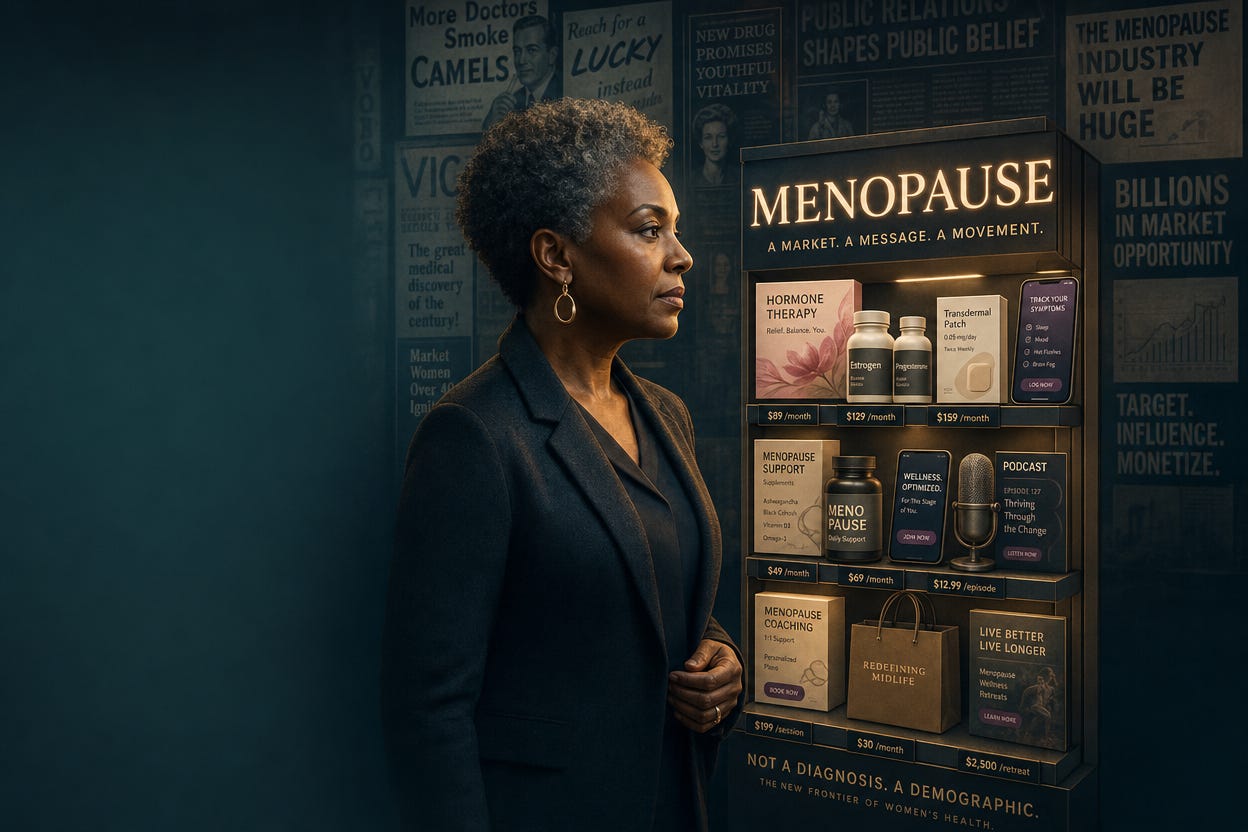
Menopause has been sold before
In the 1960s, gynecologist Robert A. Wilson published Feminine Forever, a book that helped popularize the idea of menopause as an estrogen-deficiency disease. The book did not simply argue that estrogen might relieve certain symptoms. It carried a much larger cultural message. Estrogen was framed as a way for women to preserve femininity, desirability, youth and social value.
Let’s sit there for a second.
That was not only a medical claim. That was a story about what made a woman acceptable.
The woman was not merely being offered symptom relief. She was being asked to defend her identity against aging. She was being told that the biology of transition threatened the very thing culture had trained her to protect: her femininity, usefulness, desirability and place.
Later historical accounts tied Wilson’s work to pharmaceutical support from the maker of Premarin, the conjugated estrogen product that became central to hormone therapy in that era. That history does not mean estrogen was useless. It does not mean every woman who benefited from hormone therapy was deceived. It does not mean HRT is bad.
That is not the point.
The point is that menopause has already been sold through a story that blurred medicine, fear, aging, femininity and commercial interest. That should not make us anti-HRT. It should make us honest. It should make us careful with the stories we attach to women’s bodies, especially when money is standing nearby pretending not to listen.
Because once a story gets loose, women live inside the consequences.
You live or die by the story once the story gets loose.
Then the story swung the other way
The next story came hard in the other direction.
The Women’s Health Initiative released major hormone therapy findings in 2002 after the estrogen-plus-progestin arm was stopped early because of reported risks, including breast cancer, coronary heart disease, stroke and pulmonary embolism. The trial mattered. The findings mattered. The risk signal mattered.
But the public story moved faster than the nuance.
What many women heard was not, “This specific formulation, used in this specific population, for this specific prevention question, produced this specific risk-benefit profile.”
That sentence is too long for a headline.
What many women heard was simpler: hormones are dangerous.
That story got loose.
Clinicians pulled back. Women stopped therapy. Fear entered the room. For years, hormone therapy was shaped by the shadow of a public narrative that did not always hold enough context around age, timing, formulation, route of administration, local versus systemic therapy, cardiovascular risk, clot risk, breast cancer history or where a woman was in relation to the menopause transition.
Eventually, the conversation had to make its way back to the thing that should have never left.
Context.
The problem was never that hormones were all good or all bad. The problem was that the story flattened the physiology, and women had to live inside the flattened version.
That is the pattern I am watching again.
One era sold estrogen as rescue. Another era sold fear as caution. Now this era is selling menopause back to women as empowerment, optimization, longevity, confidence, productivity, sensuality, sleep, metabolism, leadership and liberation.
Some of that is real. Some of that is helpful. Some of that is long overdue. But all of it is now happening inside a marketplace with incentives.
And incentives have gravity.
They pull the story in certain directions.
A market does not naturally hold complexity. A market wants a message that converts. It wants the woman to recognize herself quickly enough to click, buy, subscribe, book, register or believe.
That does not automatically make the market evil. It does mean the market is not the same thing as care.
That distinction is not optional.
When commercial speed outruns clinical depth
Menopause is becoming a market before it has become a fully built care model. That is the tension I cannot stop seeing.
The issue is not commerce by itself. Women need better products. Women need better services. Women need access. Women need options outside systems that have failed them. Innovation is not the enemy.
The issue is what happens when commercial speed outruns clinical depth. It is what happens when the algorithm learns women’s pain points faster than medical education learns women’s physiology. It is what happens when awareness becomes a content strategy, but understanding never becomes standard of care.
That is where women get played.
Because being seen by a sales funnel can feel eerily similar to being understood.
A headline says the thing your doctor never said. A reel names the symptom you thought was just you. A quiz gives you a category. A supplement page gives you a mechanism. A hormone clinic gives you certainty. A coach gives you language. A founder gives you a promise.
For a woman who has been walking around with a body that feels unfamiliar, that recognition can land like oxygen.
I understand why women respond.
I also understand why the marketplace is circling.
There is money in being the first person to say, “You are not crazy.” There is money in naming the thing medicine dismissed. There is money in making a woman feel like the missing piece has finally been found.
That is why the ethics have to be sharper, not softer.
Claims matter. Evidence matters. Business models matter. Language matters. The promise matters.
Recognition can still become harm
If someone says a breathing technique can eliminate hot flashes, I want to know exactly what is being claimed.
Breathwork can be useful. It can support stress physiology. It can regulate arousal. It can help a woman pause, settle and reconnect with her body. I use nervous system language in my own work because the nervous system is not decorative. It is part of the physiology.
But hot flashes are not simply a breathing problem.
Vasomotor symptoms involve thermoregulation, neurovascular physiology and the shifting hormonal environment of the menopause transition. If a woman tries the breathing technique and still wakes up drenched at 3 a.m., what happens next?
Does she question the claim, or does she question herself?
That is where harm hides.
Oversimplified marketing does not only sell false hope. It can teach women to mistrust their own bodies when the promise does not work.
And women have already had enough practice mistrusting themselves.
They have already been told the labs are normal. They have already been told it is stress. They have already been told to lose weight. They have already been told to sleep better by people who never asked why they are waking at 3 a.m. with their hearts racing. They have already been told to calm down by systems that never studied what their nervous systems were carrying.
They do not need a new marketplace repeating the same dismissal in prettier fonts.
Menopause is being made small enough to sell
The deeper issue is that menopause is too often being made small enough to sell.
One symptom, one product, one supplement, one hormone, one protocol, one lab panel, one wearable, one breath pattern, one expert, one secret, one solution they supposedly do not want you to know.
That may be good marketing. It is not good medicine.
Menopause is whole-body physiology. It involves the brain, heart, blood vessels, bones, joints, gut, liver, thyroid, adrenal system, pancreas, muscle, pelvic floor, sleep architecture, insulin signaling, stress chemistry, inflammation, pain processing, sexual health, sensory processing and nervous system load.
It is also work, caregiving, culture and race. It is surgical history, trauma history, money and access. It is whether the clinician believes the woman sitting in front of them. It is whether the workplace understands that fluorescent lights, open offices, constant interruptions and no recovery space can turn a midlife nervous system into a live wire.
It is whether a woman has been living in survival physiology for so long that “reduce stress” sounds less like advice and more like somebody mocking her life.
Stress is not always a mood.
Sometimes stress is the architecture of a woman’s life.
That does not fit neatly into a funnel.
And maybe that is why the market keeps trying to shrink it.
Small things are easier to sell. Complex systems require care.
The women who complicate the offer
This is where the women with the most complicated stories disappear first.
Black women, neurodivergent women, surgically menopausal women, cancer survivors, and women with autoimmune disease, chronic pain, metabolic syndrome, trauma histories, sleep disorders and bodies that do not follow the clean case-study arc are the women most likely to complicate the offer.
They do not always respond to the one thing. Estrogen alone may not fix it. Progesterone may not behave the way the textbook promised. A supplement may help a deficiency but not touch the life structure that keeps the body inflamed, vigilant and exhausted. Breathwork may help regulation but not replace evaluation. Lifestyle advice may be useless if it ignores racism, caregiving, night shifts, food access, sensory overload, pain, disability or the financial math of trying to stay well.
These women are not bad testimonials. They are the reason the model has to get better.
And yet they are the ones most likely to be flattened when menopause becomes a clean, shiny market category. They were already flattened by medicine. They do not need to be flattened by marketing and told it is liberation.
That is why this moment feels ethically fragile.
The market can serve care, but it cannot replace it
The question is not whether menopause should have products, programs, companies, clinics, podcasts, platforms, employer trainings, education, investment or innovation. It should. There is a real need here, and women should not have to wait another generation for help.
The question is whether the market is serving the care model or replacing it.
That is the line.
When the market serves the care model, it can improve access. It can help women find language for symptoms they were never taught to name. It can build tools, services and communities medicine should have created a long time ago. It can push old systems to stop pretending menopause is a niche concern.
But when the market replaces the care model, women are sold fragments and left to assemble the whole body by themselves.
They get a hormone fragment, a supplement fragment, a metabolism fragment, a nervous system fragment, a sexuality fragment, a workplace fragment, a longevity fragment and a mindset fragment. Then somebody calls that empowerment.
Listen, empowerment cannot mean handing a woman a pile of disconnected products and making her the project manager of the care system that failed her.
That is not liberation.
That is unpaid labor with better branding.
Complexity is the care model
A real care model can hold nuance. It can say HRT may be life-changing for one woman and inappropriate for another. It can say nutrition matters without turning food into moral performance. It can say a supplement may help a deficiency without pretending it repairs an entire endocrine transition. It can say breathwork may support the nervous system without calling hot flashes a breathing problem. It can say weight changes are metabolic, hormonal, behavioral, inflammatory and social without shaming the woman for living in a body that adapted to survive.
A care model can hold complexity.
A market often wants conversion.
Those are not the same thing.
And if we confuse them, we will repeat the same historical cycle with better branding. We will move from silence to hype and call it progress. We will move from fear to fantasy and call it empowerment. We will move from medical dismissal to commercial extraction and call it access.
That is not good enough.
The next story is being written now
The story we tell about menopause now will shape what women ask for, what clinicians prescribe, what investors fund, what employers buy, what influencers promise, what regulators ignore and what the next generation believes about its body.
That is not small.
That is medicine, culture, money and power sitting at the same table.
The cigarette did not become freedom because Bernays called it a torch. Estrogen did not become the whole answer because a book promised women they could remain feminine forever. Hormone therapy did not become the enemy because a headline made nuance disappear.
And menopause will not become good care just because the market learned how to talk about it.
That is the lesson.
Women deserve more than a better sales story.
They deserve a care model strong enough to survive the marketplace built around it.
This is the conversation I want to keep having in public.
If you are building conversations around menopause, women’s health, workplace well-being, medical dismissal, neuroaffirming care or the future of midlife medicine, I’m available for interviews, panels, podcasts, keynotes and expert commentary.
Media and speaking inquiries: https://drstaceydenise.com/media-speaking/
Sources and further reading
Edward Bernays and “Torches of Freedom”
Torches of Freedom. Wikipedia.
https://en.wikipedia.org/wiki/Torches_of_Freedom
“Public relations campaigns of Edward Bernays.” Wikipedia.
https://en.wikipedia.org/wiki/Public_relations_campaigns_of_Edward_Bernays
Brandt, Allan M. “Recruiting Women Smokers: The Engineering of Consent.” Journal of the American Medical Women’s Association, 1996.
Brandt, Allan M. The Cigarette Century: The Rise, Fall, and Deadly Persistence of the Product That Defined America. Basic Books, 2007.
Robert A. Wilson, Feminine Forever and Premarin
Wilson, Robert A. Feminine Forever. M. Evans and Company, 1966.
Feminine Forever. Wikipedia. https://en.wikipedia.org/wiki/Feminine_Forever
Watkins, Elizabeth Siegel. The Estrogen Elixir: A History of Hormone Replacement Therapy in America. Johns Hopkins University Press, 2007.
Dominus, Susan. “Women Have Been Misled About Menopause.” The New York Times, Feb. 1, 2023.
Women’s Health Initiative and hormone therapy
Rossouw, Jacques E., et al. “Risks and Benefits of Estrogen Plus Progestin in Healthy Postmenopausal Women: Principal Results From the Women’s Health Initiative Randomized Controlled Trial.” JAMA, July 17, 2002.
https://jamanetwork.com/journals/jama/fullarticle/195120
Women’s Health Initiative. Wikipedia. https://en.wikipedia.org/wiki/Women%27s_Health_Initiative
Hormone replacement therapy. Wikipedia. https://en.wikipedia.org/wiki/Hormone_replacement_therapy
Women, health care decisions and the marketplace
Ryder, Kate. The Boss: How Kate Ryder Started a Healthcare App Designed for Women. Time, April 18, 2018. https://time.com/5240071/kate-ryder-maven-healthcare-app-founder/
Women Spend $15 Billion More on Out-of-Pocket Healthcare, Deloitte Reports. Investopedia, Sept. 26, 2023. https://www.investopedia.com/women-spend-usd15-billion-more-on-out-of-pocket-healthcare-deloitte-reports-7974677