
The Disparity Paragraph Is Not the Work
Medicine understands this when it wants to.

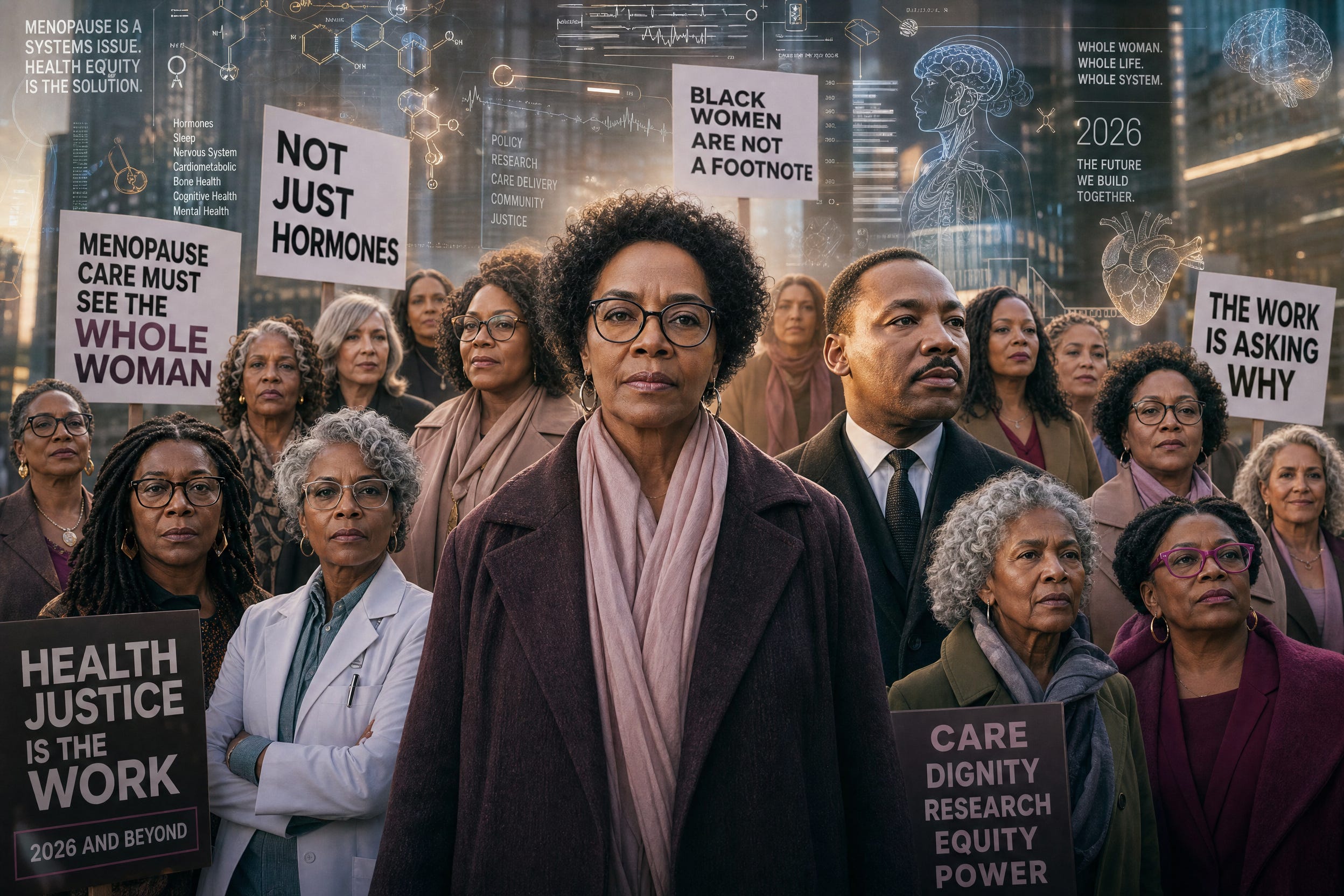
If hormones were the whole answer, the menopause conversation would already be over.
Every woman who needed HRT would be on the right dose, with the right follow-up, and she’d feel better. Every woman who lifted weights would feel her strength return the way she expected. Every woman who changed her food, bought the supplements, tracked her sleep, read the books and followed the experts would stop sitting across from a provider trying to explain a body that no longer responds the way it used to.
That’s not what’s happening.
That’s the part I keep coming back to when I listen to the public menopause conversation. So much of it still moves like there’s one missing lever. Replace the hormone. Build the muscle. Fix the pelvis. Eat more protein. Calm down. Try again.
All of those things may have a place.
But they’re not the whole place.
If they were, we wouldn’t still have millions of women wandering through midlife with brain fog, fractured sleep, metabolic changes, sensory overwhelm, mood changes, pain, palpitations, hot flashes and a private fear that nobody is seeing the full picture.
And we wouldn’t still be quoting the same disparities as if naming them were the same thing as answering them.
SWAN has been telling us for years that Black women carry a longer and more severe menopause burden. That should have changed the center of the conversation. Instead, too often, it becomes a paragraph. A slide. A sentence tucked into the diversity section before the speaker returns to the same model that already wasn’t built with us at the center.
I’m tired of quoting the statistic as if the statistic were the work.
The work is asking why.
The work is staying with the question long enough for the care model to change.
Because if Black women are having longer symptoms, more severe symptoms, more sleep disruption, more depression, more cardiometabolic risk and less access to care, that’s not a niche issue.
That’s a warning light.
And when a warning light is flashing, the answer isn’t to keep driving while congratulating ourselves for noticing it.
The answer is to ask what the system is missing.
Martin Luther King Jr. wrote, “Injustice anywhere is a threat to justice everywhere.”
That’s not only a moral statement.
It’s a systems statement.
Medicine understands this when it wants to. A problem in one part of the body doesn’t stay politely contained in that part of the body. Infection can move. Inflammation can spread. Sleep disruption can change blood pressure, appetite, pain, mood, glucose regulation and the way a person thinks. The body doesn’t care which specialty owns the billing code.
So why does menopause care keep acting like worse outcomes in one group of women are separate from the health of the whole field?
If the women with the heaviest burden are still being treated like a subgroup, then the model is telling on itself.
It’s showing us who it was built around.
It’s showing us whose symptoms are considered central and whose symptoms are treated as complications to mention after the main talk is done.
That matters because menopause care is not just a hormone conversation. It’s a pattern conversation.
And patterns don’t live in one organ.
They live in the sleep a woman isn’t getting. The stress she’s been carrying. The food her body can tolerate. The gut that’s inflamed or reactive. The blood pressure that changed. The glucose that crept up. The workplace she has to survive. The room that’s too loud. The doctor who rushed her. The family she still has to care for. The culture that taught her to push through. The nervous system that has been reading threat for longer than anyone has been asking better questions.
That’s a life story written into physiology.
This is where my training shapes how I see the problem.
I didn’t train inside a narrow pelvis-only frame. I trained first in general surgery, then pediatric surgery. That kind of training doesn’t let you pretend the gut is separate from nutrition, inflammation, infection, fluid status, pain, stress, recovery and the family standing at the bedside trying to understand what just happened.
The body is one conversation.
Menopause care should be too.
That doesn’t mean hormones don’t matter. They do. HRT can be life-changing for the right woman, at the right time, with the right clinical context and follow-up.
But hormones are speaking inside a larger system.
They’re speaking to a nervous system that may already be on high alert. They’re speaking to sleep that may already be fractured. They’re speaking to a gut that may already be reactive. They’re speaking to a metabolism that may already be strained. They’re speaking to a brain that may have spent decades reading rooms, code-switching, masking, over-functioning, caregiving and performing calm.
So if the answer keeps arriving as one lever, one protocol, one supplement stack, one pellet, one patch, one food rule, one dumbbell or one reminder to reduce stress, then we’re not practicing whole-person care.
We’re handing women a smaller map and acting surprised when they still feel lost.
This is why The Nervous System Eats First is not a slogan to me.
It’s the clinical argument.
Before a woman can sleep, digest, focus, desire, recover, metabolize, connect or feel steady in her own body, her nervous system has to stop interpreting life as a threat.
That can’t happen if the care model keeps ignoring the room she lives in, the body she’s lived in, the culture she’s moved through, the stress she’s had to metabolize and the symptoms she’s already been taught to minimize.
And for Black women, that room is not abstract.
It includes medical dismissal.
It includes being undertreated for pain.
It includes being read as stronger than we are supported.
It includes being expected to function while carrying stress loads nobody wants to count as clinical data.
It includes walking into exam rooms where the provider may see the body before they hear the story.
So no, I don’t want another disparity paragraph.
I want the disparity to change the question.
Because the question isn’t only whether women are being treated poorly in menopause.
The question is which women the menopause conversation keeps building itself around.
If menopause science can’t explain the women with the heaviest burden, it’s incomplete.
If menopause care can’t improve outcomes for the women most likely to be dismissed, it’s unfinished care.
And if the public conversation keeps building itself around the women already closest to access, the rest of us will keep being handed the same narrow menu.
That’s not enough.
We can do better than a hormone war.
We can do better than treating Black women’s menopause outcomes like a side note.
We can do better than calling disparity awareness progress when the care model still doesn’t know what to do with the women naming the disparity.
The work is asking why.
The work is demanding that the scientific community keep pushing until the answers change outcomes.
The work is building care that can answer.
Because if Black women are carrying the heaviest menopause burden, they are not outside the story.
They may be showing us exactly where the story has been too small.
If the usual menopause advice hasn’t explained your body, start with the Color Archetype Quiz. Your symptoms may not be random. Your nervous system may be the pattern nobody mapped yet.