
The Masks We Wore Personal Reflections | The Nervous System Eats First
My perfectionism was not a personality trait.

I want to tell you something I did not fully understand until I was well into my forties.
My perfectionism was not a personality trait.
My obsessive need for control was not a character flaw.
My shopping, the hit of acquisition, the brief moment of feeling like I had agency over something, was not a discipline problem.
They were my nervous system doing the only thing it knew how to do. Keeping me alive inside conditions that were never designed for a child to survive.
I grew up in a household where violence was the background noise. Where a child could be told at five years old that she came into this world alone and would die alone. Where being too much, asking too many questions, needing too much, feeling too intensely, was a problem to be managed rather than a child to be met.
So the nervous system did what nervous systems do. It reorganized itself around one priority. Not connection. Not curiosity. Not creativity.
Safety.
And the tools it built to maintain that safety were brilliant. Perfectionism meant nobody could find the cracks. Control meant I could manage the external environment when the internal one was a territory I had no map for. Shopping meant there was one moment in the day when something felt chosen, felt mine, felt like relief, even if the relief lasted about as long as it took to get home and put the bag down.
I didn’t know any of this while I was doing it. That is the thing about survival adaptations. You do not choose them consciously. They choose you. And then they run so quietly in the background for so long that you start to mistake them for who you are.
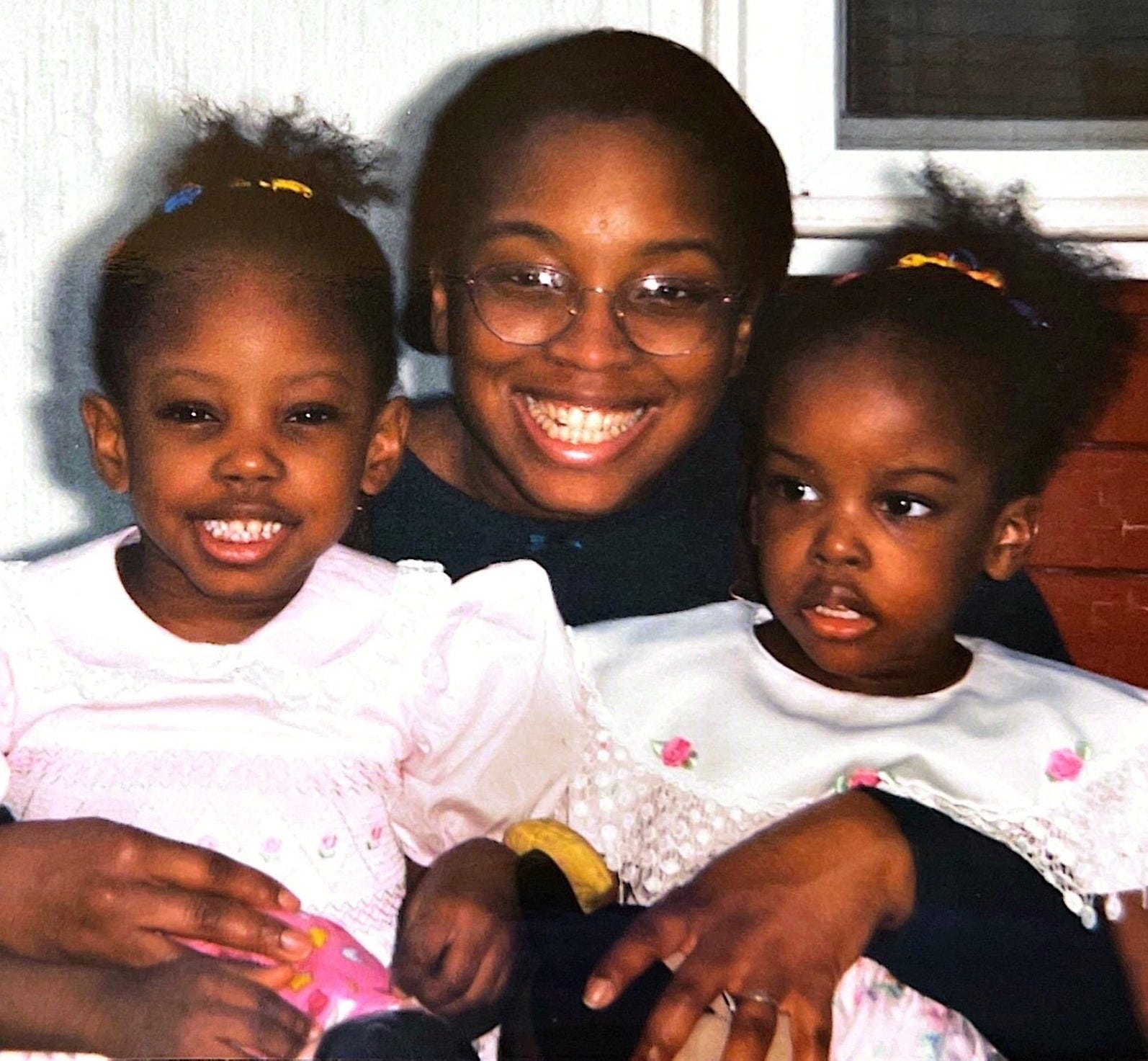
By 22 I was a mother to two daughters. I was determined to give them materially what I had not had. And I did that. I succeeded at that. I succeeded at almost everything that could be measured.
What I did not understand yet was that I was also transmitting what I had not healed. Not intentionally. Not with any awareness. But the nervous system that learned to survive by suppressing, performing, and achieving was the only model my daughters had for what it looked like to be a woman in the world.
Suppress what you feel. Perform what is required. Achieve your way through the pain.
Never let them see you crack.
When they sat me down years later, grown women by this time, and told me what they had witnessed, I finally understood something the science had been documenting for years. A parent’s unhealed nervous system does not stay private. It transmits. Not just behaviorally. Biologically. Through attachment, through early care, through the epigenetic record that stress leaves on a developing child’s neuroendocrine system.
The research on intergenerational stress transmission is not abstract to me. It is the story of my family across at least three generations.
And it is the reason I eventually turned to art.
I want to be precise about why art got there when everything else could not. Because this is not a soft claim. This is the reason behind the Neuroaesthetic Reset Method™.
I have alexithymia. My nervous system feels enormously. But the bridge between sensation and language is unreliable. I could sit in a therapy session and know something was happening in my body , tension, weight, something without a name, and have absolutely no words for it.
Art does not require words. When you put color on a surface, when you allow form to emerge from what your hands are doing, you engage neural pathways that bypass the prefrontal cortex’s demand for language and logic. For someone with alexithymia, or in a trauma state where the language centers are offline, this is the difference between having a pathway to the interior and having none at all.
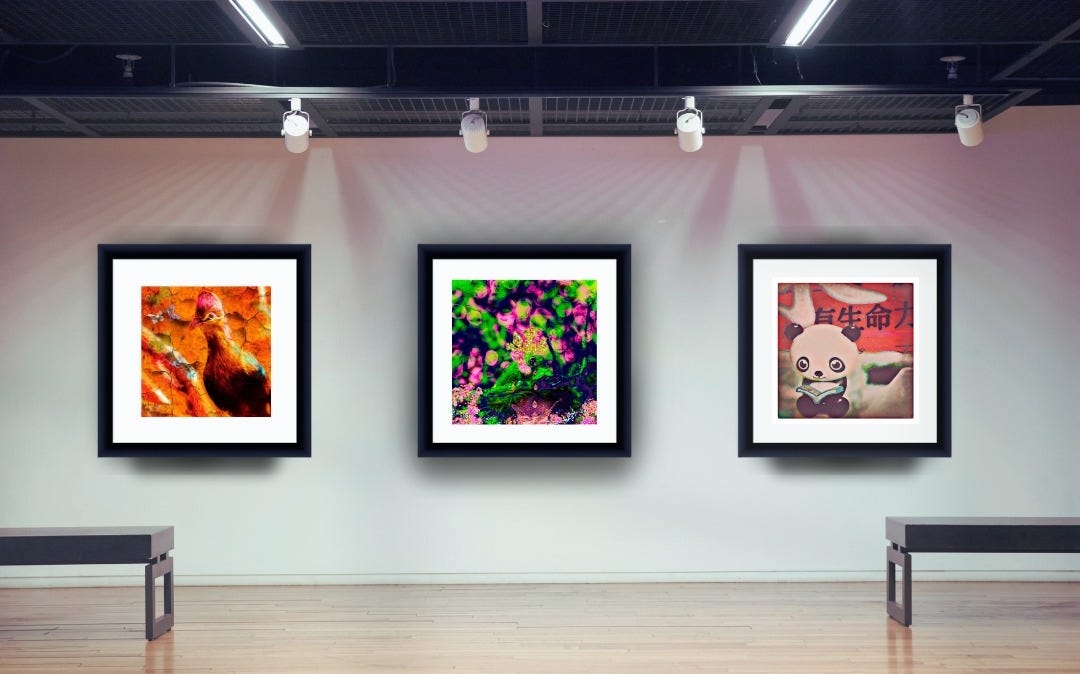
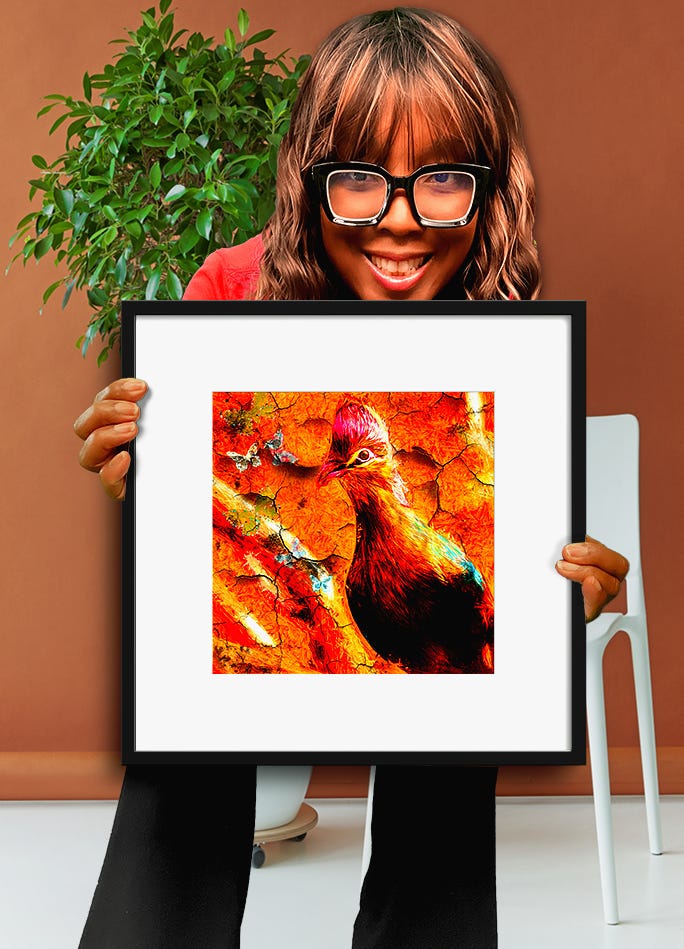
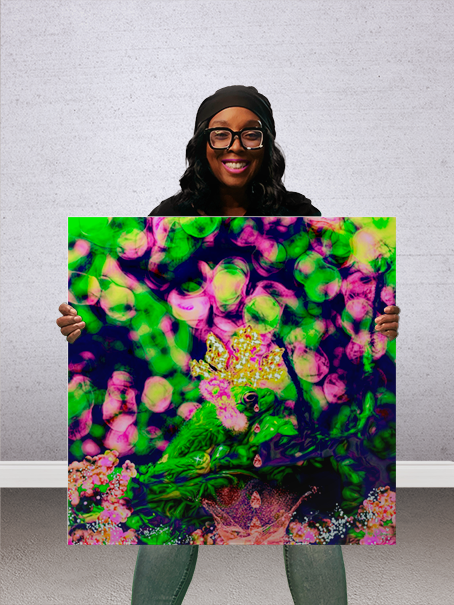
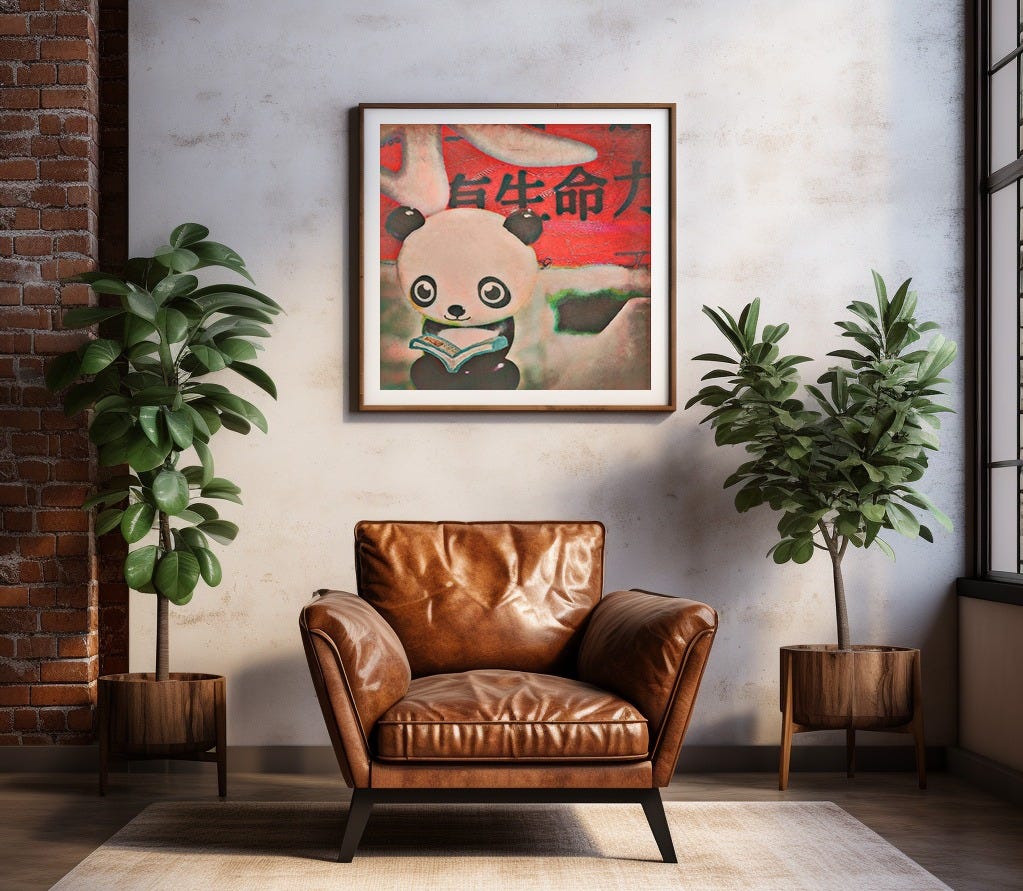
The three pieces I made in that season, Fiery Orange Chicken, Forgotten at the Bayou, Panda’s Storytime, were not made to be beautiful. They were made to be honest.
Fiery Orange Chicken started with a childhood memory. Familiar food in an environment where most things were not safe. The bold oranges and blues of something reaching for warmth, for temporary comfort, for the thing that takes the edge off long enough to keep going. When I look at that piece now, I see a nervous system reaching for regulation through the only channels available to it. That is not weakness. That is intelligence under constraint.
Forgotten at the Bayou came from the Frog Prince, the fairytale I had absorbed as a child as instruction about love. Wait. Be patient. Be good. The rescuer is coming. The blood-diamond tears in that piece are the grief of having organized your emotional life around the belief that someone else will finally make you safe and discovering, later than you would have liked, that the rescue was never going to arrive from outside.
Panda’s Storytime is about the stories themselves. The narratives became refuge not because they were true but because they were predictable. Predictable is a form of safety when nothing else is. And the invitation in that piece is the one I am still living into, the stories that shaped you do not have to be the stories that define you. You can rewrite them. You always could.
What therapy helped me see and what art let me feel were the same thing arriving through different doors.
The perfectionism and control were symptoms of unprocessed trauma. Not character. The fearful-avoidant attachment that made closeness feel simultaneously necessary and terrifying, not personality. The behavioral adaptations I had built around the wound were not me. They were what the wound looked like when it was trying to keep me functional.
Meeting the shadow, Carl Jung’s term for the parts of ourselves we suppress because they conflict with who we think we are supposed to be , required giving it form I could look at. The rage that had nowhere to go. The grief that had been performing as numbness for decades. The child who was told she was too much, who had been waiting inside me this entire time to be finally seen.
You cannot integrate what you will not look at.
Art gave me a way to look.
I am not telling you this story from a safe distance. I am telling you this story from inside an ongoing practice of choosing to keep going back, back into the parts that are still tender, still being integrated, still finding their form.
Healing is not linear. It took decades to build these adaptations. It has taken years of sustained, uncomfortable, often exhausting work to begin integrating them. And I am not done.
But I am more real than I have ever been. More present. More capable of genuine connection than any version of myself that was still running entirely on survival mode could ever have been.
That is worth every single step.
The nervous system eats first. Before the hormones. Before the labs. Before the supplements and the sleep protocols and the environmental interventions.
If the nervous system never learned that it was safe, if the coping mechanisms it built to survive are still running the show decades later, now meeting the hormonal recalibration of perimenopause without the buffer that estrogen and progesterone used to provide, then the body is fighting a battle on two fronts.
And nobody told her that.
Nobody connected the perfectionism she has been called driven for her entire career to the child who learned that excellence was the only protection she had.
Nobody connected the shopping, the control, and the inability to stop performing even when she is alone and exhausted and there is no one left to perform for, to a nervous system that never learned it was allowed to rest.
That connection is the clinical work.
That is what the Neuroaesthetic Reset Method™ is built on.
Not the aesthetics. The nervous system. The part that ate first. The part that has been waiting the longest for someone to finally show up and say, “I see what you were doing. I understand why you did it. And you do not have to keep doing it anymore.”
I want to ask you something before you go.
Not a quiz question. Not a clinical intake. Just a real question from one woman to another.
What is the mask you have been wearing the longest?
Not the one you chose. The one that chose you. The one that started as survival and stayed so long you started to think it was your face.
You can put it in the comments. You can keep it to yourself. You can just sit with the question.
But I want you to know , I asked myself the same question. And answering it honestly was the beginning of everything that came after.
The Nervous System Eats First is published by Dr. Stacey Denise Moore, MD, FACS, board-certified surgeon, Lifestyle Medicine physician, late-diagnosed autistic woman, and founder of The Neuroaesthetic MD™. This publication sits at the intersection of clinical medicine, nervous system science, and the honest reckoning with what it costs a woman’s body to survive brilliantly for decades without being fully seen.
If this resonated, subscribe. Share it with the woman in your life who is still performing fine.