
What I Love Boosters Reminded Me About What Work Gets Wrong About Midday Mealtime
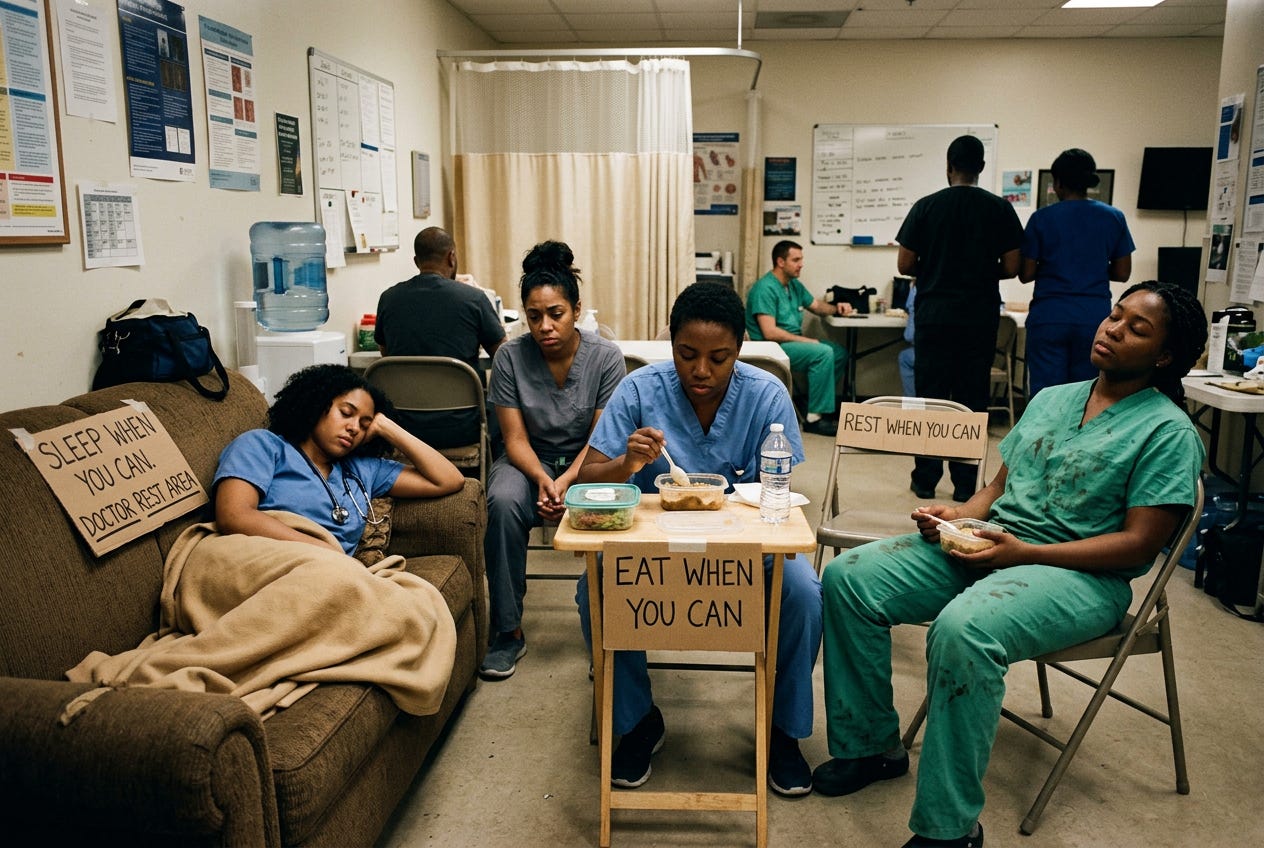
Sleep when you can, eat when you can, pee when you can.

I watched I Love Boosters the other day. And there’s a lunch scene I haven’t been able to let go of.
The workers don’t get a lunch break. They get called to eat like they’re being called to run a race. They line up, move fast, grab what they can, swallow it under pressure, and get back to work. While the manager above them sits down and actually enjoys his meal.
It’s played for laughs. But it landed for me because the exaggeration was just telling the truth with the volume turned up.
Most workplaces don’t literally make you sprint to the cafeteria. But a lot of workdays are built on exactly that same logic. Eat when you can. Squeeze it in. Take the call. Answer the Slack message. Don’t look unavailable. And please don’t let your body be too visible in the middle of all this productivity.
Then everybody wants to know why the brain’s foggy by 3 p.m.
Listen. That’s not a personal failing. That’s a design problem.
Sleep when you can, eat when you can, pee when you can.
That was the motto in general surgery training. We passed it down from one exhausted resident to the next like a survival code, because the system had no real plan to protect your body. It meant: grab it now because there’s no guarantee you’ll get another chance.
And here’s what that motto actually taught us, whether we knew it or not. It taught us to disconnect from our body’s signals and just keep moving. To treat eating as something you squeezed in between cases, not something the body actually needed to function.
I can tell you from experience that a meal eaten standing up between cases, half a cold sandwich swallowed in three minutes, doesn’t do the same thing in your body as a meal eaten sitting down with your nervous system even halfway settled. The food was the same. The body receiving it was not.
That difference showed up later. Fatigue. Brain fog. The kind of irritability that doesn’t have an obvious source. I didn’t learn what a rushed meal costs from a textbook. I learned it from what my body felt like at the end of a call shift versus a day with actual breathing room in it.
What surgery trained into me was considered a feature of the system, not a flaw. We were supposed to be proud of surviving it. But I’ve spent the years since watching that same logic applied to working women everywhere, dressed up in the language of productivity and hustle. And it’s doing the same damage.

You can’t separate what you ate from how you ate it
Food doesn’t enter a spreadsheet. It enters a body. Your body. And your body has a whole nervous system that decides what to do with that food before your brain even registers that you’ve eaten.
Rest and digest isn’t just a cute phrase from a wellness blog. It’s physiology. When your nervous system is in mobilization, rushed, scanning for the next interruption, braced for another demand, it’s not receiving that meal the same way it would if you had five actual minutes to chew, breathe, and just be a person eating.
That difference shows up later as fatigue, irritability, brain fog, bloating, cravings, glucose dips, and the kind of afternoon crash that gets written off as poor focus or low discipline. But the crash isn’t the story. The crash is the receipt.
Now add the menopause transition on top of that
Think about the woman who woke up at 3 a.m. and never really went back to sleep. She had a hot flash in the car before she opened her laptop. Her appetite cues are different than they were two years ago. Her safe foods may have narrowed. Her gut’s more reactive. Her blood sugar’s less forgiving of the skipped meal or the bolted lunch. She’s carrying sensory overload from the lights, the open office floor plan, the commute, and the constant performance of keeping her face calm while her body’s doing something entirely different underneath it.
Now put her in a back-to-back meeting day and tell her to eat better.
With what time? With what appetite? With what nervous system state?
Because here’s what the workplace conversation keeps missing. The question isn’t just what she’s choosing to eat. The question is what kind of workday the food is being asked to enter.
That’s where we need to get more honest. Not blaming. Not shaming employers into installing salad bars. Honest about structure. Honest about what we’ve decided to treat as optional.
The culture of urgency is a metabolic variable
If your workplace rewards coffee over lunch, urgency over recovery, and back-to-back meetings over basic biology, don’t be surprised when the bodies in that workplace start sending distress signals through performance.
The brain isn’t floating above the body in a glass conference room. It needs glucose stability to think. It needs hydration to function. It needs enough nervous system safety for food to actually land as nourishment instead of just another task to survive.
This isn’t soft. This isn’t a wellness trend. This is the physiology of how a brain actually works, and we keep acting like it doesn’t apply from 9 to 5.
For women moving through perimenopause and menopause, that gap between what the workday asks and what the body needs isn’t theoretical. It shows up in real time. And for Black women, who are already carrying the documented physiological weight of chronic allostatic load, flattened cortisol patterns, longer and more severe symptom burden in the SWAN data, the margin is even smaller. There’s less room for a system that treats eating as an interruption.
I’m just saying. The body’s been keeping a running tab. And eventually it submits the bill.
And for the sensory-sensitive woman, it’s even more layered
Food isn’t always simple. Not for everybody. For some of us, food is smell, texture, temperature, appetite, memory, nausea, executive function, decision fatigue, and safety all at once. And the healthy choice may be nutritionally correct and still feel impossible to the body that has to eat it.
If you’re in a season where only a few foods feel safe, being told to overhaul your diet right now may not help. And I’m not saying that as a consolation prize. I’m saying it because meeting your nervous system where it actually is gives your body a chance to begin trusting food again.
Sometimes the move isn’t replacement. It’s addition. Keep the safe food. Add one thing beside it. Add protein where you can. Add fiber where it fits. Add color, warmth, or texture in a way your body can actually tolerate right now. That’s not lowering the bar. That’s working with the body you have today, not the one you think you should have.
You follow what I’m saying?
What the workplace can actually do
I’m not asking employers to become food police. Grown women don’t need workplace lunch monitors. But workplaces do have a role here, not as the nutrition authority, but as the room where a lot of women are trying to stay employed while their bodies are doing something significant.
Protect real lunch breaks. Not thirty minutes with a laptop. An actual break. Build meeting rhythms that leave room for eating and returning to yourself before the next thing starts. Offer food options that go beyond pastries, a vending machine, and whatever caffeine can carry through the afternoon. Stop making every pause look like disengagement. Treat nourishment as part of the performance infrastructure, because that’s what it is.
What I Love Boosters showed me in that one lunch scene is that a rushed meal is a message. It tells your body: hurry up, stay useful, don’t need too much, get back in line.
Women in the menopause transition are already carrying enough invisible labor. They shouldn’t have to prove their bodies matter by crashing in public.
If we want women to keep leading, deciding, creating, and staying in the room, the room has to make space for the body that does all of that work.
You can’t keep demanding executive function from a body you won’t give time to fuel.
And you can’t keep calling it a performance problem when the workday was designed like eating is a luxury.
The lunch break isn’t the opposite of productivity.
It’s one of the reasons productivity is biologically possible at all.
That’s all I’m saying.
Dr. Stacey Denise is a board-certified surgeon transitioned into lifestyle medicine specializing in the menopause transition. She sees patients in California, DC, Georgia, Kentucky, Maryland, Ohio, Texas, and Virginia.