
Your Office Is Too Loud for Menopause
This is why sound belongs in the workplace menopause conversation.


When we talk about menopause at work, most people hear the word “workplace” and immediately think about people. They think about the manager who needs more awareness, the HR team that needs a clearer policy, the benefits package that needs to catch up and the company culture that still treats women’s health like a private inconvenience.
All of that matters. A manager who doesn’t understand menopause can misread physiology as attitude. A policy that doesn’t allow flexibility can turn a temporary bodily transition into a career threat. A culture that rewards constant availability can push talented women into silence until that silence becomes burnout, disengagement or exit.
But there’s another part of the workplace conversation we keep skipping.
The room itself.
The office is not neutral. The room is not just a container where work happens. It has a texture, a temperature, a rhythm and a soundscape. It has light that either helps the body settle or keeps it bracing. It has air that feels cooling or stale. It has corners that offer privacy or expose people all day long. It has sound that either softens the nervous system or keeps asking it to work harder than anyone can see.
That’s why workplace design cannot stay in the category of aesthetics, decor or brand experience. Design is not just how a room looks in a brochure. Design is what the body has to live through while it’s trying to think, decide, lead, remember, regulate and stay connected.
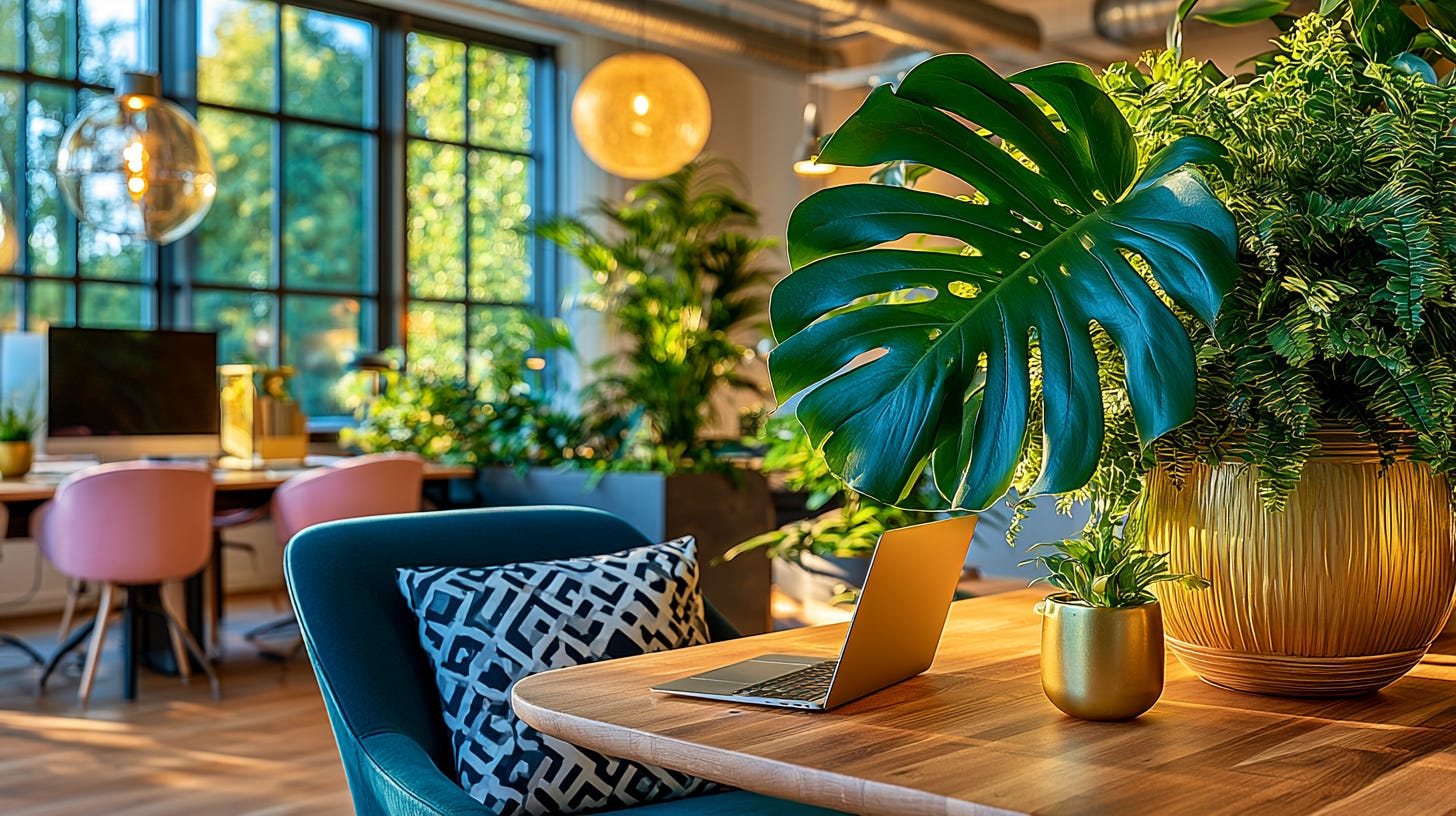
I think about this the same way I think about biophilic design. When we bring plants, natural textures, daylight, organic shapes and living materials into a space, we’re not only trying to make the room prettier. We’re trying to bring the body back into relationship with cues it recognizes. We’re trying to make the room feel less like a machine and more like a place a nervous system can inhabit.
Sound belongs in that same conversation.

Nature is not silent, but it rarely sounds like an open-plan office. There’s a difference between rain on a window and three overlapping conversations beside your desk. There’s a difference between birdsong in the distance and the high-pitched scrape of chairs in a conference room. There’s a difference between the low rhythm of wind through trees and the constant spillover of phones, keyboards, Slack pings, HVAC hum and people talking through thin walls.
The body knows the difference.
And for a woman moving through perimenopause or menopause, that difference may start to matter in a way it didn’t five years ago.
She may walk into the same office she has worked in for years and feel like someone changed the settings on the room. The lights feel harsher. The room feels hotter. The floor plan feels louder. The meeting that used to drain her a little now wipes her out before lunch. She may not have language for it yet. She may only know that the email takes longer, the conversation is harder to track, the sound follows her from room to room and by the time she reaches her car after work, she needs a few minutes of quiet before she can go home and be somebody’s wife, mother, daughter, friend or self.
This is where workplaces make a mistake.
They wait until the output changes and then start writing a story about the woman. She seems distracted. She seems less engaged. She doesn’t speak up like she used to. She’s not as available. She’s not handling pressure the way she once did.
But what if the workplace is only seeing the last chapter of a story the body has been telling all day?
What if she is not disengaged?
What if she is trying to perform inside an environment that no longer matches her nervous system?
That’s the part sound helps us see.
Most offices treat sound as background, but the nervous system doesn’t. The nervous system is always listening. It is always sorting. It is always deciding what can be ignored, what needs attention and what might require a response. Speech is especially demanding because the brain tries to make meaning from it even when the conversation has nothing to do with you. So when a woman is trying to write one email while hearing a coworker’s call, another conversation near the printer, chairs moving in the conference room and notifications hitting every few minutes, her brain is not simply “being distracted.” It is being asked to filter the room before it can even do the work.
That filtering has a cost.
Now place that cost inside a body that woke up at 3 a.m. and never fully settled back to sleep. Place it inside a body managing hot flashes, night sweats, glucose swings, palpitations, pain, brain fog, mood changes or sensory sensitivity that has gotten sharper. Place it inside a Black woman who may already be navigating the extra load of being misread, over-scrutinized or expected to perform calm in rooms where she cannot afford to be perceived as anything other than composed. Place it inside an autistic or ADHD woman who has spent decades masking how much the environment costs her.
Now ask her to lead the meeting, answer quickly, remember names, control her tone, manage the room and keep producing as if nothing has changed.
That is not a neutral workplace.
That is a room asking the body to pay a bill nobody has named.
This is why acoustic design belongs in the menopause-at-work conversation. Not because every office needs to become silent. Silence is not the goal. A workplace is a living environment. People will talk. Phones will ring. Work will make sound. The question is whether the room is designed to hold that sound in a way that lets people think, or whether it throws sound back at the body all day long.
A conference room that echoes is not just annoying. It changes how much energy it takes to listen. An open floor plan with no acoustic boundaries is not just collaborative. It can become a constant demand on attention. A desk beside the printer, the break room or the busiest hallway is not just a seat assignment. It can become the difference between a woman having enough cognitive energy for the afternoon or spending the rest of the day trying to recover from the room.
And once you see that, the solution cannot be only awareness.
Awareness matters. Manager training matters. Policy matters.
But awareness doesn’t quiet an echoing room. A policy sitting in a folder doesn’t soften harsh sound. A webinar doesn’t change the fact that someone doing complex cognitive work may be sitting in the loudest part of the building.
If the environment keeps overloading the body, an organization can say the right words about menopause and still lose the women it claims to support.
That is why I use a People, Policy and Place frame when I talk about menopause at work. People matter because managers, HR teams, colleagues and leaders need enough literacy to stop mistaking physiology for poor character. Policy matters because flexibility, disclosure safety, meeting norms, benefits and recovery windows determine whether support is actually usable. But place matters because the body still has to sit somewhere, and that somewhere is either helping her regulate or making her spend the day surviving the room.
Sound is part of place.

A workplace can reduce sound load without turning the office into a library. It can soften echo in conference rooms. It can use acoustic panels, ceiling clouds, textiles, rugs, plants, dividers and softer surfaces as part of the visual language of the room, not as an afterthought. It can create zones where deep work is actually protected. It can stop placing people who need focus beside printers, break rooms, reception desks and hallway intersections. It can make noise-dampening tools normal instead of treating them like secret accommodations.
And none of this should require a woman to disclose every private detail of her menopause, autism, ADHD, migraines, anxiety, sleep disruption or sensory overload before the room becomes easier to work in.
That is the point of designing for the nervous system under load.
The spillover helps everyone. A workplace that becomes easier for a sensory-sensitive woman in the menopause transition to occupy also becomes easier for the employee with migraines, the ADHD employee trying to hold focus, the older employee managing hearing changes, the exhausted caregiver, the person recovering from illness and the team trying to do deep work in a room built for interruption.
That is not special treatment.
That is intelligent design.
The company that understands this stops asking why experienced women are leaving and starts asking what the workplace is costing them to stay. Because a woman can be clinically supported and still return to an environment that drains her before lunch. She can be doing the right things for her body and still spend the day inside a room that makes regulation harder. She can care deeply about her work and still look checked out when her nervous system is overloaded.
That is the danger of ignoring place.
We turn environmental load into a character judgment.
But the better question is not, “What is wrong with her?”
The better question is, “What is this room asking her body to carry?”
The office is not just where menopause symptoms appear. Sometimes the office makes them louder.
So if organizations are serious about retaining women through perimenopause and menopause, the workplace strategy has to move beyond awareness. It has to move beyond a policy PDF. It has to move beyond telling women to speak up while leaving the same sensory conditions untouched.
Menopause at work needs people, policy and place.
The nervous system enters the workplace whether the handbook names it or not.
And if the room is part of the burden, the room has to become part of the solution.
Bring Dr. Stacey Denise, The Neuroaesthetic MD™, to your organization for physician-led workplace menopause education and nervous-system-informed strategy.
"We turn environmental load into a character judgment." This sums why I refuse to go back to working in an office --- especially working with men and women who don't understand peri and menopause. I worked in radio for many years--- a very toxic environment and of course, the workspace design wasn't set up to nurture my nervous system.
Great post Dr. Stacey! 🔥 - Michelle